Naming a business usually fails for one of two opposite reasons: too little raw material, so the same five names circle in your head for a week, or too little scrutiny, so you fall for the first decent name and only discover the domain is taken after you have told your accountant. A working method fixes both at once. Set the constraints before you generate anything, produce far more candidates than you need with the business name generator, then eliminate hard. What survives the elimination round is worth registering. What does not was never the name, just the first idea wearing its clothes.
This is a method article, not a legal one. It will tell you what to check before you commit to a name; it will not tell you the fee or the timeline for checking it, because those change and vary by country, and a wrong number here is worse than no number.
Step one: set constraints before you generate
Decide three things before you touch a generator. How many syllables can the name have and still be said once and understood: two or three is the safe range, four starts costing you on the phone. Does it need to describe what the business does, or can it be abstract: a bakery can be called Bright Oven or it can be called Solstice, and both are legitimate strategies, but picking one before you generate keeps you from grading apples against oranges later. And what is off limits: a word your business partner hates, a word too close to a competitor's name, a sound that means something unfortunate in a language your customers speak. None of this takes long to write down, and skipping it is the single biggest reason people generate two hundred names and like none of them.
Step two: generate in volume
Type one keyword into the generator, the word that most concretely describes the business, and click Generate. A single word works better than two, since the tool strips spaces and punctuation before building anything, so "coffee roasting" becomes the clumsy "coffeeroasting" rather than two usable ideas. Each click produces up to 18 names, and every click is a fresh random batch: clicking nine or ten times before judging anything gives the generator a real chance, since any one batch is a small, biased sample of what it can produce.
Behind the button, the generator draws from five fixed patterns with different odds:
| Pattern | Share of results | How it is built | Typical shape (keyword "bakery") |
|---|---|---|---|
| Suffix compound | ~25% | Keyword plus one of 20 curated endings (ly, hub, works, forge, pike…) | Bakeryly, Bakeryhub, Bakeryworks |
| Prefix compound | ~20% | One of 15 curated openers (go, try, neo, prime…) plus keyword | Gobakery, Trybakery, Neobakery |
| Two-word pairing | ~40% | Keyword next to one of 15 pairing words (harbor, anchor, summit…), either order | Bakery Harbor, Anchor Bakery |
| Portmanteau | ~15% | The first roughly 60% of the keyword's letters plus one of 10 invented tails (ora, eno, ix…) | Bakora, Bakeno, Bakix |
Duplicate names within a batch are filtered automatically, so 18 results are 18 distinct candidates. Because the word banks are fixed and shared by every visitor, two people typing the same keyword can land on the same suggestion; that is a reason to treat every output as a starting point to modify, not a name to register unmodified.
A worked pass
Say the keyword is "ledger," for a bookkeeping service. A run of batches turns up a mix across all four shapes: a suffix name that reads like software (Ledgerforge), a prefix name that reads like a slogan (Trueledger), a pairing that reads like an agency (Ledger Harbor), and a portmanteau that reads like a startup (Ledora, from the first three letters of the keyword plus an invented tail). None of those four is automatically the answer. What the pass does is force a comparison of four different registers side by side, in about ninety seconds, which is faster than most people arrive at their first idea by staring at a blank page.
Step three: eliminate hard
Take your shortlist, five names at most, and run each one through a short sentence: "I ordered it from ___," or whatever sentence fits how a customer would actually say the name out loud. A name that sounds natural there and awkward on a sign, or the reverse, tells you something real about it. Then do the two checks that actually kill names: whether the .com domain and the social handles you need are free, and whether the name or something confusingly close to it is already registered as a trademark in your country. In the United States, the USPTO's trademark search is the place to start that second check; other countries run their own registers. Both checks are pass or fail. A name that fails either one gets dropped from the shortlist regardless of how much you like it, because the alternative is building a brand on a name you may be forced to change later.
Step four: check that the survivor works as a URL
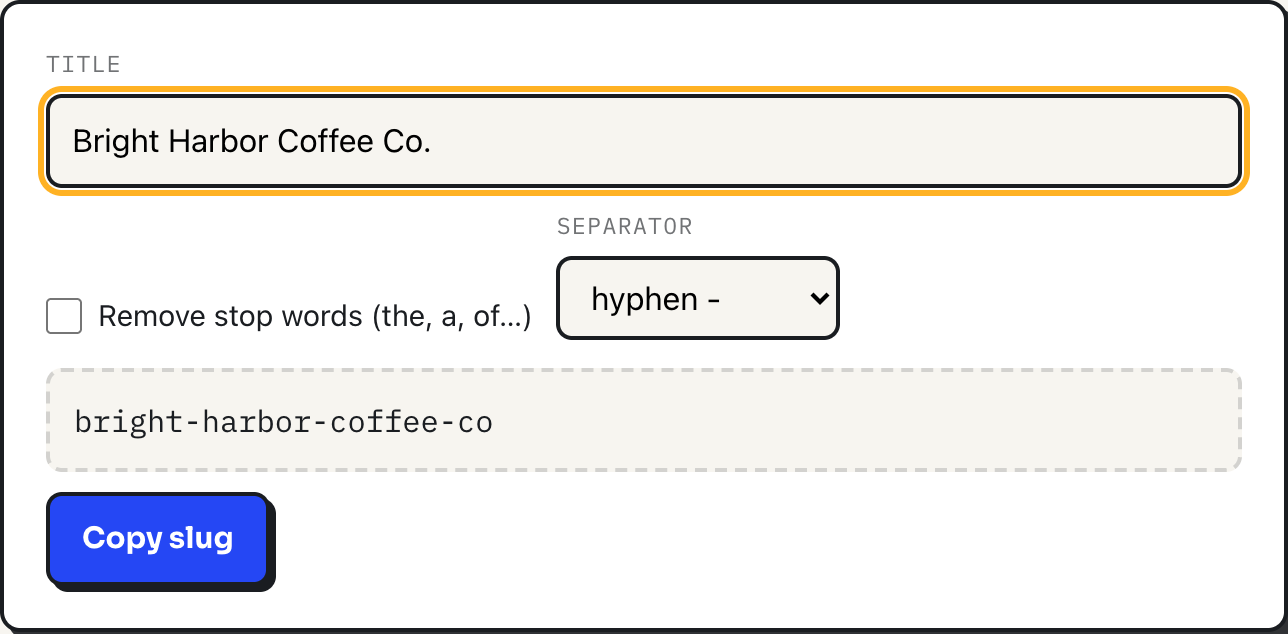
A name can pass every check above and still make an awkward web address. Run the finalist through the slug generator the way the lead example above does: type the full name, including "Co." or "Studio" or whatever else you would put on a sign, and look at what comes out. Spaces disappear, punctuation disappears, accented letters flatten to plain ones, and everything lowercases into hyphenated words. If the result is short and reads cleanly, the name works as a domain and a URL path. If it collapses into something long or confusing, that is worth knowing before you register anything, not after.
Where the generator stops being useful
The word banks are small on purpose, which is what keeps results fast and readable, but it also means a long or unusual keyword produces weak results: a three-syllable-plus keyword mostly only works well through the portmanteau pattern, since the other four just tack letters onto an already long word. The generator has no idea what a name means in another language, whether it clashes with an existing brand, or whether the domain is free; those are exactly the checks in step three, and no generator can substitute for doing them. Treat the output as raw material for editing by hand, not a finished shortlist. The name you eventually register is very often a hand-altered version of something the generator produced, not the exact string it gave you.
What to do
- Write down your syllable limit, your description-versus-abstract choice, and your off-limits list before opening the generator.
- Type one keyword, generate at least eight or nine batches, and keep a running shortlist of five instead of judging the first screen.
- Say each shortlisted name in a sentence out loud before checking anything else.
- Check domain and social handle availability, then check the trademark register in your country, and drop any name that fails either.
- Run the survivor through the slug generator to see its URL shape before you register it anywhere.